Sécurité matérielle
.avif)


Sécurité technologique

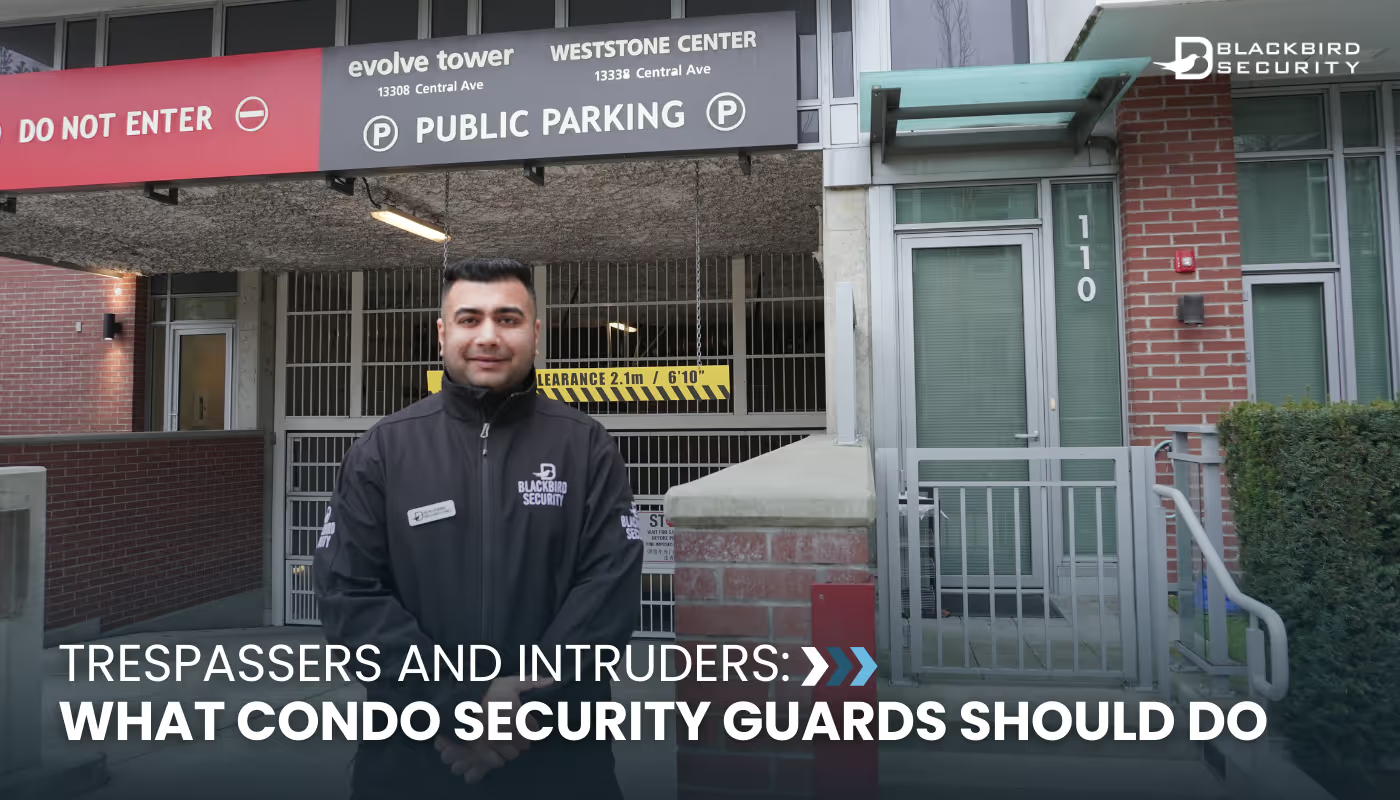
Unauthorized access is a security issue often encountered by condominium security guards. Condos can sometimes house hundreds of residents, many of them entering and exiting the building during peak hours, such as before and after work. Despite a concierge security guard’s careful monitoring of the front door and CCTV cameras, combined with their familiarity with residents, unauthorized access can happen. That’s why it’s essential for residential security guards to understand the protocols they need to follow when addressing issues of trespassing and intrusion.
We’ve assembled this guide to help condo security guards and property managers understand what actions guards should take in the event of a trespassing or intrusion incident, and how to proactively prevent trespassing before it occurs.
Looking for a different topic? Find out more information about condo security in our Definitive Guide to Condominium Security.
The definitions of trespassers and intruders share overlap in that they both refer to individuals who have gained unauthorized access to a property, but they differ in one key way: A trespasser is a person who has entered a property without permission, while an intruder is a person who has entered a property with the intent to commit a crime or cause harm.
A trespasser may be unaware that they are trespassing, while an intruder has intentionally gained access to private property with the intent to harm others, steal, or commit property damage, making intruders a far more serious threat than trespassers.
Canadian provinces each have their own individual acts concerning trespassing. For example, BC’s Trespass Act and Ontario’s Trespass to Property Act differ on when a person must leave the property (Ontario specifies “immediately” after being given notice, while BC says “as soon as practicable”). It’s important for security guards to be familiar with their province’s local laws, ideally receiving training in this area, but there are commonalities across provinces.
A person is guilty of trespassing if:
They are on a property without the express permission of the “occupier” (the person who owns or is responsible for the property), and
They do not leave the property after being directed to do so.
In the next section, we’ll cover a key piece of federal law that determines how security guards can respond to trespassers who don’t vacate the premises when directed.
If a trespasser does not have permission to be on a property and refuses to vacate after being instructed to do so, under Section 494 of the Criminal Code of Canada, a security guard may conduct a citizen’s arrest using reasonable force. Here’s what the section says:
(2) The owner or a person in lawful possession of property, or a person authorized by the owner or by a person in lawful possession of property, may arrest a person without a warrant if they find them committing a criminal offence on or in relation to that property and
(a) they make the arrest at that time; or
(b) they make the arrest within a reasonable time after the offence is committed and they believe on reasonable grounds that it is not feasible in the circumstances for a peace officer to make the arrest.
To put it in simpler terms:
Security guards may make a citizen’s arrest of anyone found to be committing a criminal offence on the property they protect.
They must make the arrest at that time or shortly thereafter. Guards cannot arrest a trespasser multiple days after the incident took place.
Some guards, such as tactical security guards, receive training in the Use of Force, equipping them with the knowledge and skills to make a citizen’s arrest. While any citizen can make a citizen’s arrest, it is not advisable in every situation. Security guards should consult with their team leads or managers to understand when they should or shouldn’t make a citizen’s arrest.
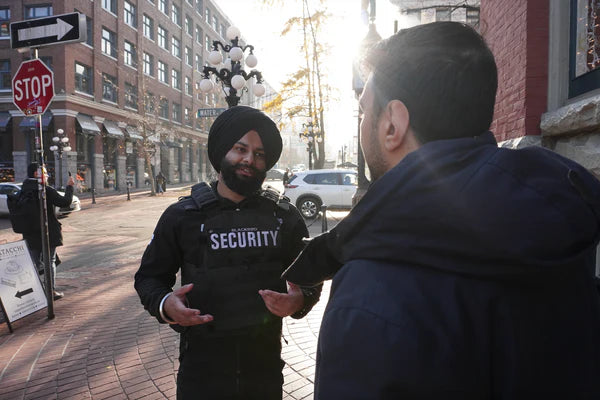
Next, we’ll detail the step-by-step protocol security guards follow when confronting a trespasser. It’s important to note that the difference between an intruder and a trespasser (ie, someone who intends to commit harm vs someone who does not) is not clearly defined until the person is witnessed causing harm. Guards cannot know a trespasser’s intentions, so they should exercise caution while maintaining a calm demeanour throughout the process.
When a guard suspects an individual of trespassing, they should monitor and locate them before attempting to establish contact. The guard may have spotted the trespasser over condo CCTV cameras, been alerted to their presence by a resident, or spotted an unfamiliar person walking through the front door.
If the person has not been witnessed causing harm and does not appear to be a threat, guards should observe their behaviour from a distance before proceeding to the next step. If the individual appears to be a danger or is acting erratically, guards should call 911 and keep bystanders at a safe distance.
If deemed safe to do so, the guard should verbally greet the person, maintaining distance. If the person is found roaming the halls, stairs, or another common area, the guard should request that they move to the front desk for visitor check-in.
It’s essential for guards to remain calm and professional during the initial contact, without approaching the individual with a hostile or aggressive attitude. The person may have a legitimate reason for being on the property, and a negative approach reflects poorly on the client’s property. Aggression can additionally escalate tensions and lead to more serious situations.
Next, the guard should ask the person the reason for their visit, their name, and the name and unit number of the person they’re visiting. Guards should remain neutral and ask questions one at a time, giving the individual time to respond to each.
If the person responds with information, the guard records their answer and verifies the name and unit number of the person they’re visiting to ensure both are accurate. If they are, the guard allows the person to proceed with their visit. However, if the person is behaving suspiciously, is visibly under the influence of drugs or alcohol, or is being disorderly, the guard should ask them to leave.
If the person is unable or unwilling to provide information, the guard should politely but firmly ask them to leave, stating the reason they are being denied access. If the person refuses to leave, the guard can call 911.
If the person becomes aggressive and a danger to others in the vicinity, the guard may make a citizen’s arrest if they have the training to do so. A member of the security team should call 911 immediately.
Once the incident has been resolved, whether it resulted in a call to 911 or the trespasser leaving peacefully, the guard must write a report detailing the incident. They must record the date and time it took place, an account of what happened, and any actions taken by security personnel.
Again, it’s impossible to know whether a person intends to commit harm until they are witnessed or reported doing so. If they have not been witnessed causing harm and don’t appear to be a threat, guards should follow the above trespasser protocol.
If the person was seen damaging property, forcing entry, or committing another illegal act, guards should dial 911 immediately and should keep bystanders at a safe distance. They should not attempt to approach the intruder, as they may be armed.
Once the incident has been resolved, security guards should create a report detailing the nature of the incident, the time it occurred, and their actions taken in response. Guards may be asked by police to provide a statement.
A professional security guard is far better equipped to handle these scenarios than residents or building staff. Security guards receive specialized training that equips them with strategies for handling trespassing incidents. Individuals who confront trespassers without training are more likely to escalate the situation into something dangerous.
Blackbird Security guards undergo advanced training through our industry-leading in-house training program, Blackbird Academy, where they receive training in de-escalation techniques, Canadian criminal law, nonviolent crisis intervention, legislation and legal authority, and first aid. These training modules ensure our guards can effectively respond to and peacefully resolve all security incidents that may arise in a residential environment, including trespassing.
Relying on untrained individuals to handle and respond to security incidents can be dangerous. However, as we’ll discuss in the next section, residents and property managers can still help keep condos secure and support security efforts within their communities.
Management teams and strata councils can use the following tips to proactively keep their buildings secure when combined with a professional condo security strategy.
Establish a protocol for quickly reporting concerns to security teams. Educate residents on signs of suspicious activity, such as unauthorized access, broken doors and locks, loitering, and unsecured access points.
Post visible signs at entrances and parking garages that communicate that the building is professionally secured.
Educate residents about the dangers of tailgating, and post signs at parking garage entrances reminding residents to wait for the gate to close behind them.
Ensure residents are aware of the correct procedures for visitor registration, package deliveries, and emergencies.
Encourage residents to speak openly with guards about safety concerns and share security updates in newsletters, meetings, or bulletins.
Following these tips helps ensure a safe and secure environment for everyone in the building.
Trespassing is a risk that carries the potential to cause serious harm in unprotected buildings. When condos partner with professional security teams, residents feel safer, more secure, more connected with their community, and enjoy peace of mind knowing help is on hand when it’s needed most.
Get in touch with our team to learn how we can help keep your property protected.
Curious to learn more about residential security? Check out our Definitive Guide to Condominium Security.





.avif)
.avif)
.avif)